
How local leaders leverage Clarity to solve complex challenges
July 16, 2026
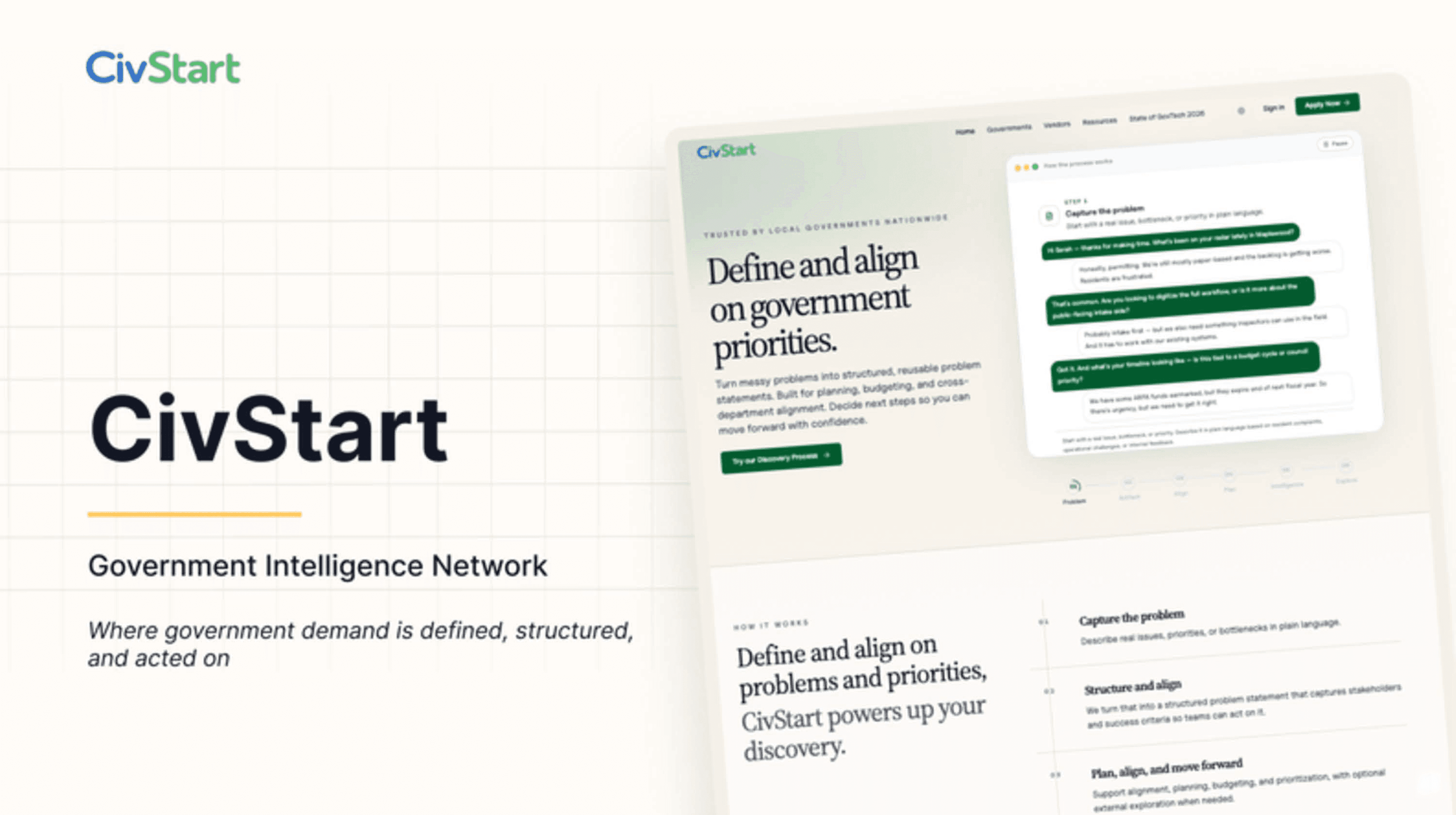
Local government leadership has never been more complex. Between infrastructure challenges, evolving public expectations, and the rapid pace of technological change, today’s local leaders are often managing issues that do not have a single department owner.
When a challenge spans public safety, IT, resident services, finance, operations, or other functions, the hardest part is not always finding a solution. It is defining the problem clearly enough for the organization to move forward.
This is where Clarity, CivStart’s decision-intelligence platform for government, can support local decision-makers, including city managers and other senior leaders.
Clarity is designed to help turn a scattered challenge into a structured starting point for alignment, planning, and action.
From Complex Issues to Structured Problem Statements
Local government initiatives often begin with a mix of emails, spreadsheets, meeting notes, resident feedback, and operational observations. The frustration may be clear, but the technical, financial, and operational requirements can remain hard to pin down.
Clarity supports this process through structured discovery.
By entering raw observations about a challenge, such as a permitting backlog or a breakdown in community engagement, local leaders can move toward a structured problem statement that is easier for internal teams to use.
That problem statement does more than describe the issue. It helps identify key stakeholders, outline constraints such as budget, staffing, timing, and existing systems, and define what success should look like. Just as importantly, Clarity can surface peer context so teams can understand how other governments have approached similar challenges, what lessons they learned, and where useful comparisons may exist.
Driving Cross-Departmental Alignment
One of the greatest hurdles in local government is getting different departments aligned around the same challenge. When a local leader introduces a new initiative, it can quickly create friction because each department sees the issue through its own responsibilities, systems, and constraints.
Clarity helps reduce that friction by creating a shared starting point for priorities.
By synthesizing inputs across functions such as IT, finance, operations, resident services, and department leadership, Clarity helps teams begin from a common understanding. That shared definition can reduce the back-and-forth often required to reach consensus, shifting the conversation from “what is the problem?” to “what should we do next?”
Peer Insight and Smart Solution Exploration
A local leader’s time is one of their most valuable resources. Researching how other municipalities have approached a similar challenge can take dozens of hours, especially when the issue cuts across departments or service areas.
Clarity helps accelerate that early research by providing broader context on how peer governments have navigated similar challenges.
This exploration happens before external engagement or procurement. Local leaders can use Clarity to better understand the challenge, compare approaches, and consider what kinds of partners or tools may be relevant while staying in control of when, how, and whether to engage externally.
When teams do decide to explore the market, they can do so with a clearer understanding of their own needs, constraints, and success criteria.
Beyond the Basics: Patterns, Capacity, and Organizational Insight
Clarity can also support longer-term organizational learning.
Many challenges are not one-time issues. They show up as recurring bottlenecks, repeated resident concerns, staff capacity constraints, or patterns that slow down progress across departments.
By helping teams structure these recurring signals, Clarity can become a practical tool for understanding where friction exists, where priorities are forming, and where a clearer definition of the problem could help leadership make better decisions.
By turning discovery into a repeatable, structured process, local leaders can move from scattered inputs to clearer priorities, stronger alignment, and more confident next steps.