
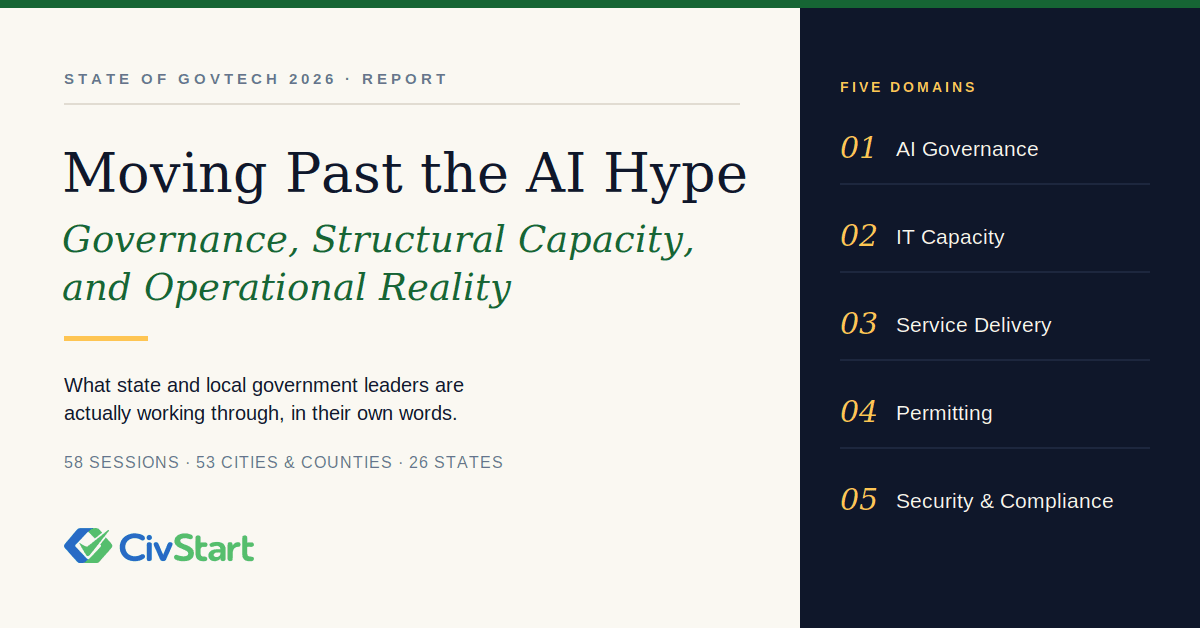
Five Operational Domains, Mapped From the Field
The CivStart State of GovTech 2026 analysis marks a pivotal shift in the public-sector innovation landscape. While earlier years were dominated by exploratory questions around artificial intelligence adoption and generalized technology modernization, data captured through CivStart’s decision intelligence tool, Clarity, demonstrates that government leaders have moved beyond the surface level hype. They are now grappling with the structural realities of operating modern digital government at scale.
By analyzing 58 discovery sessions with state and local government leaders — spanning Chief AI Officers, CIOs, Chief Innovation Officers, and network operations leads — Clarity moved past generalized panel discussions to map the actual, lived operational friction points facing today’s public-sector operators. Below is a synthesis of the five primary operational domains identified through Clarity.
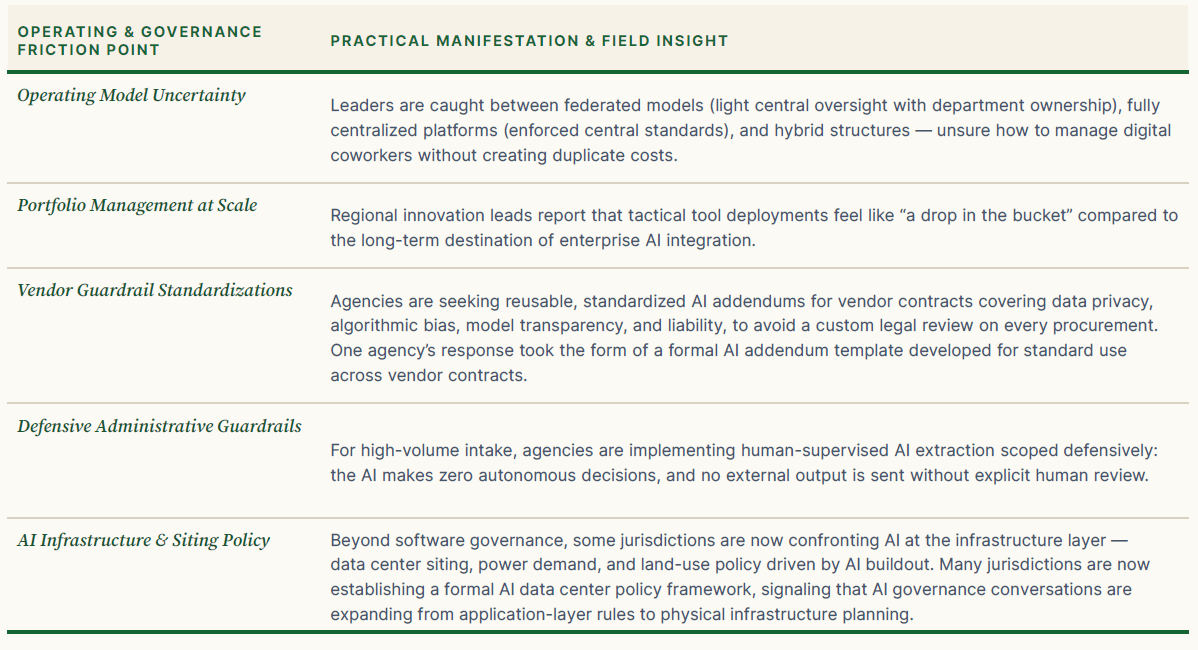
- AI Governance, Operating Models, and Vendor Guardrails
- IT Capacity, Funding, and Technology Intake Governance
- Service Delivery Modernization: Paper Elimination and Resident Access
- Permitting, Land Use, and Regulatory Clarity
- Security and Compliance Operations Readiness
Real Problems, in Government Leaders’ Own Words
Most public-sector research relies on surveys: leaders self-report against a fixed set of questions, months after the fact.
This report draws on something different: live, unprompted problem-diagnosis conversations captured through Clarity,
CivStart’s decision-intelligence tool, as state and local government leaders used it to work through real operational
challenges in real time.
What this means is that a leader opening a diagnostic session isn’t answering a survey question — they’re describing,
in their own words, the problem actually in front of them. That produces qualitative detail a structured survey doesn’t
capture. We see the specific breakdown between a city clerk and a county building office, the exact reason a shadow-IT
purchase happened, the internal politics behind a stalled procurement. This report is built from that layer of specificity.
Sample
This analysis draws on 58 discovery sessions initiated ahead of the 2026 State of GovTech Summit, spanning 53 cities
and counties across 26 states. Sessions range from brief problem statements to full structured deep-dive diagnostics;
22 sessions in this window completed a multi-turn deep-dive, in which Clarity asks targeted follow-up questions to
move from a surface complaint to a root-cause diagnosis. Where this report cites a specific case, it draws on sessions
where the leader’s role, jurisdiction, and challenge were confirmed and, where named, shared with permission — and is
otherwise presented without identifying the jurisdiction.
How the Themes Were Identified
Not every session includes a confirmed name, title, or jurisdiction — many government leaders use Clarity
anonymously by design, particularly during early exploration. Where this report references “government leaders”
broadly, it reflects the full sample; where it references specific roles (e.g., Chief AI Officers, CIOs), it reflects the subset
of sessions where that role was explicitly confirmed.
The five operational domains in this report are synthesized recurring patterns across jurisdictions — a qualitative
thematic analysis grounded in the actual language and priorities leaders brought to the tool, not a keyword count or
predetermined taxonomy. This approach lets patterns emerge from what leaders are actually struggling with, rather
than forcing responses into categories set in advance.
Two layers of data inform this synthesis. The first is verbatim: what a leader typed, their stated title, and their
jurisdiction. The second is Clarity’s own AI-generated diagnostic synthesis — context, hypotheses, and follow-up
questions the tool produces in response. This report treats the first layer as primary evidence and the second as an
analytical aid, cross-checked against primary sources before any specific figure is published.
Downloads
Unlock CivStart's Resources
Don't miss out on these key insights for public and private-sector leaders in state and local government. Not available anywhere else!
Recommended
Email delivery
Get access to this resource for you and your team.
Email Delivery
Get the full guide
Step 1 of 2
Submit your email and the PDF will be sent as an attachment.