
Introduction
The 2026 BRIDGES Conference in New York City proved to be a critical crucible for public-sector innovation. As government leaders from cities, counties, and education agencies converged to discuss the future of public administration, the sheer velocity of change, especially driven by artificial intelligence, has brought underlying institutional friction points to the surface.
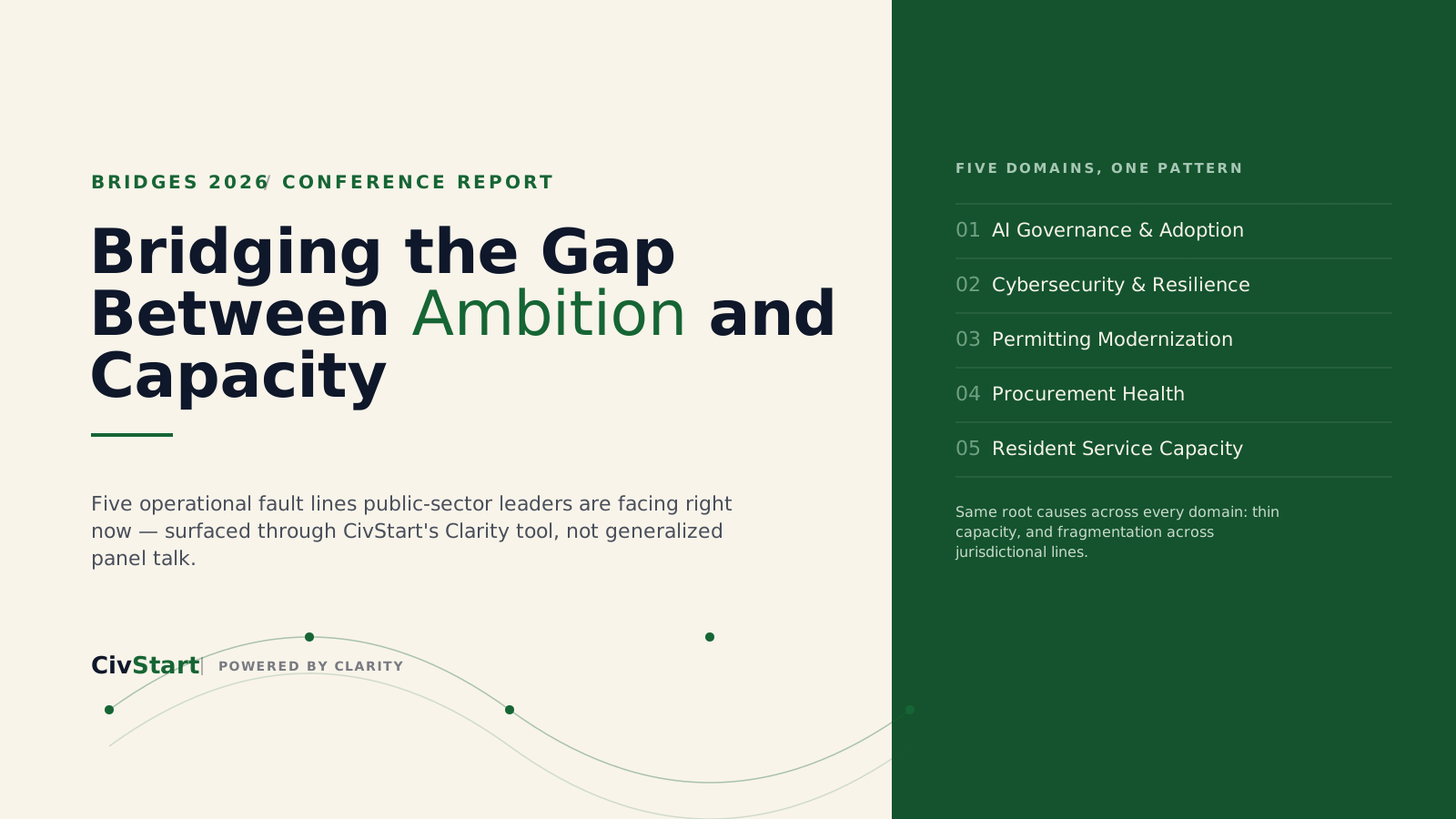
Using CivStart's Clarity tool leading up to and during the BRIDGES Conference, we moved past generalized panel discussions to map the actual, lived challenges facing public-sector operators today in all their complexity. Below is a synthesis of the five primary operational domains identified through Clarity.
AI Governance and Responsible Adoption
Artificial intelligence has transitioned from a futuristic talking point to an urgent operational demand, creating a palpable sense of anxiety across the public sector. The single biggest pattern emerging from Clarity is that government leaders feel an overwhelming pressure to deploy AI tools to improve efficiency, yet they completely lack a foundational starting framework to do so safely.
This tension is felt universally, from large municipal departments to resource-constrained regional education agencies across the country.
Most agencies are forced to navigate the brave new world of algorithmic tools with small, overworked teams and zero dedicated AI, legal, or privacy staff.
Leaders are desperate to figure out how to scope their first internal governance plans and data management strategies without reinventing the wheel. They are worried about public trust and transparency; specifically, how to explain algorithmic or automated decisions to citizens before a high-profile controversy forces a reactive, defensive posture.
Furthermore, internal workforce alignment remains a massive hurdle. Employees fear that AI is either a "cheating tool" that undermines human effort or an existential threat to their jobs. Bridging this gap requires establishing clear measurement cadences for what constitutes "just enough" adoption versus "too much."
Compounding these internal challenges is the equity trap: deploying sophisticated digital-first tools into communities where a significant percentage of residents still lack reliable home internet and devices. To combat this, agencies are focusing on low-risk, high-value pilot use cases such as knowledge management systems and virtual assistants to handle repetitive, data-entry-driven staff work.
Finally, leaders highlighted the terrifying reality of external, AI-enabled threats such as deepfakes, manipulated media, and targeted violence threats that cross jurisdictional boundaries, requiring entirely new cross-agency response protocols between schools, local police, and county administrators.
Cybersecurity and Operational Resilience
While AI captures headlines, the foundational digital infrastructure of local government remains exposed to mounting threats and legacy decay. Public-sector cybersecurity discussions at BRIDGES revealed an industry struggling to establish basic visibility over its own digital and physical assets.
For many municipalities, the core dilemma is simply figuring out where to start: conducting a reliable cybersecurity posture assessment requires untangling a decades-long web of asset dependencies, legacy software, and shadow IT.
The stakes are acutely high for critical infrastructure, particularly water and wastewater utilities, the power grid, and communications. Leaders in various sessions highlighted the immense difficulty of securing Operational Technology (OT) and SCADA systems. Water authorities must map complex asset inventories, clarify system ownership, segment networks, and execute phased remediations, all without causing disruptions to clean water delivery. There were similar complexities expressed across other critical infrastructure organizations and agencies.
Beyond digital defense, operational resilience demands robust continuity planning. When historical emergency-management arrangements between cities and counties dissolve, agencies are forced to rapidly stand up independent, city-owned continuity-of-operations (COOP) capabilities from scratch. These technical and structural hurdles underline a broader truth: local governments cannot secure their communities against modern cyber threats in a vacuum. They urgently require coordinated, multi-jurisdictional frameworks that bridge the gap between municipal IT departments, county emergency managers, and local law enforcement.
Permitting and Regulatory Process Modernization
For citizens and developers, local government is often judged by the speed and predictability of its permitting and regulatory processes. Yet, Clarity data shows that lengthy review cycles are rarely the result of intentional statutory delay. Rather, they are structural symptoms of fragmented internal workflows and poor intake quality.
Across jurisdictions, the dominant structural archetype is the sequential multi-agency review handoff. Instead of departments reviewing applications concurrently, files bounce sequentially from zoning to environmental to building safety, creating a black hole of accountability where applicants lose weeks or months at each transition.
Compounding this is the hidden engine of backlogs: intake quality. As some leaders noted, incomplete or fragmented initial submissions routinely slip through front desks, triggering endless resubmission cycles that choke downstream review teams. Furthermore, applicants are frequently trapped in invisible mazes of split city and county responsibilities where neither entity owns the full timeline.
Leaders are discovering that diagnosing backlogs requires honest introspection, separating true volume spikes from staffing shortages or broken process design.
Until agencies can accurately diagnose these bottlenecks and communicate realistic, transparent timelines to frustrated applicants, public trust in regulatory bodies will continue to erode. This same friction extends inward, where internal authorization workflows for public records requests create similar administrative logjams.
Procurement Health and Vendor Engagement
Public procurement is supposed to foster competitive markets and deliver the best value for taxpayer dollars, but local governments are finding themselves trapped in a cycle of thin bid pools and heavy administrative friction.
In some municipalities, routine solicitations frequently attract only one or two repeat bidders. Leaders are left questioning whether this lack of competition is driven by broader market vendor scarcity or internal process friction such as burdensome registration portals, poor public visibility into upcoming pipelines, or overly rigid scopes of work.
At the same time, agencies face a massive educational burden. Some leaders are trying to scale consistent, accurate contractor-facing guidance regarding complex labor compliance and workforce requirements without burning out limited procurement staff. Meanwhile, sustainability mandates are adding new layers of data collection complexity, requiring departments to centralize and report vendor compliance metrics they are ill-equipped to track.
Perhaps the most strategic vulnerability identified in procurement is the erosion of long-term community value.
When under-resourced counties are pressed for quick cash or administrative relief, they risk trading away permanent public infrastructure. As shared by one county, their team is structuring solicitations to aggressively preserve long-term public assets such as reserving land easements and utility corridors prior to executing one-time asset sales which requires a level of strategic foresight and contract design that many municipal procurement offices are rarely staffed to handle.
Resident Service Capacity and Institutional Knowledge
Local government agencies are caught in a classic squeeze: citizen expectations for 24/7, frictionless digital service.
Such expectations are skyrocketing, while internal workforces are shrinking, aging, and grappling with massive institutional brain drain.
In many cities, 311 demand composition is overwhelming call centers with repetitive, information-only contacts. Leaders are desperate to deflect these routine inquiries to digital self-service channels rather than resorting to expensive headcount expansions. For suburban and county governments, the challenge is maintaining after-hours 311 coverage using a single, understaffed day shift.
Beneath these surface-level service demands lies a deeper structural decay: undocumented and personality-driven internal processes. As noted by one leader at BRIDGES, many municipal operations run entirely on "tribal knowledge" locked inside the heads of long-tenured employees. When those employees leave, services become wildly inconsistent for residents, exposing a massive governance and accountability gap.
This fragmentation extends to public records and meeting media, which are often scattered haphazardly across legacy digital platforms with no authoritative home.
Until agencies can unify their internal knowledge repositories and automate routine resident touchpoints, they will remain perpetually reactive, hostage to staff turnover and administrative burnout.
Conclusion: Turning Complexity into Action with Clarity
The insights gathered at this year’s BRIDGES conference prove a vital reality: public-sector leaders are not short on vision, ambition, or dedication. Rather, they are navigating an era of unprecedented operational complexity: balancing the immense promise of artificial intelligence against the gritty realities of legacy cybersecurity, stubborn permitting backlogs, strained procurement pipelines, and vanishing institutional knowledge.
Read individually, these five domains look like separate operational silos. Read together, they share two structural roots. The first is a capacity gap: agencies are being asked to govern AI, harden critical infrastructure, and modernize permitting and procurement with the same small, generalist teams that were sized for a simpler era — no dedicated AI or privacy staff, no cybersecurity headcount to match OT exposure, no procurement bandwidth to catch predatory deals before they're signed. The second is jurisdictional fragmentation: authority and information are split across city and county lines, departments reviewing the same permit application in sequence rather than in parallel, cyber response protocols that dissolve at municipal borders, and institutional knowledge trapped in individual employees rather than shared systems. Neither gap is solvable by a single department acting alone — which is precisely why they surfaced independently across AI governance, cybersecurity, permitting, procurement, and resident services. The fix isn't five separate initiatives; it's building the shared infrastructure — of staff capacity, cross-jurisdictional coordination, and institutional memory — that every domain is missing.
When these challenges are left isolated within individual departments, they feel insurmountable. But when aggregated, structured, and analyzed collectively, they reveal shared patterns and shared solutions.
Clarity
This is where CivStart’s Clarity tool transforms the equation. Clarity is designed to bridge the gap between day-to-day operational friction and strategic decision-making. By continuously capturing, organizing, and synthesizing the real-time challenges voiced by public-sector leaders, Clarity ensures that no agency has to solve these complex problems in a vacuum. The Clarity tool provides more than just clarity for leaders today. It also provides connections and confidence. As leaders use Clarity, they are provided connections to peers and solution providers who have already addressed the challenge, pressing issue, or opportunity that the leader is gaining clarity about. These connections are invaluable as they help the leader know that they are not alone and perhaps even more importantly, they do not need to reinvent the wheel. Additionally, leaders are presented with immediate questions to consider regarding the uniqueness of their challenge and clearly defined next steps and action items to allow them to facilitate conversations, make decisions, and move forward with confidence.
Your Next Steps with Clarity:
- Diagnose with Precision: Stop guessing where your agency's friction lies. Use Clarity to surface the hidden bottlenecks in your permitting workflows, procurement processes, digital readiness, or any of the myriad of other pressing issues you face today.
- Benchmark with Peers: See how neighboring municipalities, counties, and education agencies are successfully tackling the exact same AI governance, cybersecurity hurdles you face today, and other top challenges of the day.
- Turn Feedback into Strategy: Empower your leadership teams and under-resourced staff with data-driven insights that justify resource allocation, shape policy, and rebuild public trust.
The challenges of modern governance are too heavy to carry alone, and the pace of technological change leaves no room for hesitation. We invite you and your teams to leverage CivStart’s Clarity to cut through the noise, align your workforce, and turn operational complexity into clear, actionable progress.
Ready to bring Clarity to your agency? Connect with the CivStart team to learn how your organization can integrate decision intelligence into your upcoming modernization roadmap.
Downloads
Unlock CivStart's Resources
Don't miss out on these key insights for public and private-sector leaders in state and local government. Not available anywhere else!
Recommended
Email delivery
Get access to this resource for you and your team.
Email Delivery
Get the full guide
Step 1 of 2
Submit your email and the PDF will be sent as an attachment.